Witte de Withstraat
Amsterdam-West
Bags and cardboard next to the underground container, reported via the app.
Cleaned up and separated · before/after photo to the reporter
Klean Up · Cleanup on demand
Photo and location in the app. Once your report is reviewed and accepted as a priority incident, a Klean Up worker with an electric cart is on site within 24 hours — with before/after photos back in the app. Regular, duplicate, incomplete or out-of-scope reports get a separate status.
Now active in Amsterdam Nieuw-West
Klean Up is currently running as a field test in Osdorp / Nieuw-West. We're working towards a structural service for the district. During this phase we pick up reports based on location and type — not every report gets action today.
What we do
Reports come in via web, WhatsApp or existing channels, with photo and location. We instantly know where it is and who picks it up; a human reviews before a team heads out.
Teams see clusters, priority and routes per neighbourhood. Service windows per urgency and capacity make execution plannable instead of ad hoc.
Every completed report gets a before/after photo. Residents see feedback, management sees hotspots and reports.
Circular, not in the bin. We don't just clean up, we separate and recycle. Deposit bottles, glass, metal and plastics go back into the loop — saving the municipality residual-waste costs and helping meet sustainability targets.
This week in Nieuw-West
Every completed report closes with a before/after photo for the reporter. This is the field-test counter — no forecast, just what happened.
Preview figuresField-test and demo reports counted together — not a production metric yet. The label disappears once the counter runs on real reports only.
Live from the reporting app · refreshed every 15 minutes · Last cleanup 34 hours ago
Report litterThe proof
No “we have received your report” — but proof in the app that it's been cleaned up. For the reporter, and for everyone in the neighbourhood.
Bulky waste and bags next to the container, reported via the app with photo and location.
Cleaned up by a Klean Up worker. Proof photos back in the app — reporter and neighbourhood see the result.
Example scenario
From the field test
Three places where the approach was already running before any contract existed. Reported with a photo, collected with the electric cart, separated and disposed of — with a before/after photo back to the reporter.
Amsterdam-West
Bags and cardboard next to the underground container, reported via the app.
Cleaned up and separated · before/after photo to the reporter
Nieuw-West
First round through the starting area: dumped waste and litter around container locations.
Deposit bottles cashed in · materials disposed of at Recyclepunt Sneevlietweg
Since September
Reports from the neighbourhood are picked up by location and type during the field test.
Counter above · every report with proof in the app
We only share addresses and images with the reporter's consent — hence text here, no photos.
The difference
Residents currently share dumped waste in group chats and hotlines with no coherence. See the same morning as one list where someone is responsible, with route and proof.
dark = loose photos, nobody picks them upsea green = one list with route and proof, someone responsible
Example scenario. Service windows are steering information per urgency and capacity, not a hard promise.
How it goes now
4 loose reports · nobody picking them up · no proof
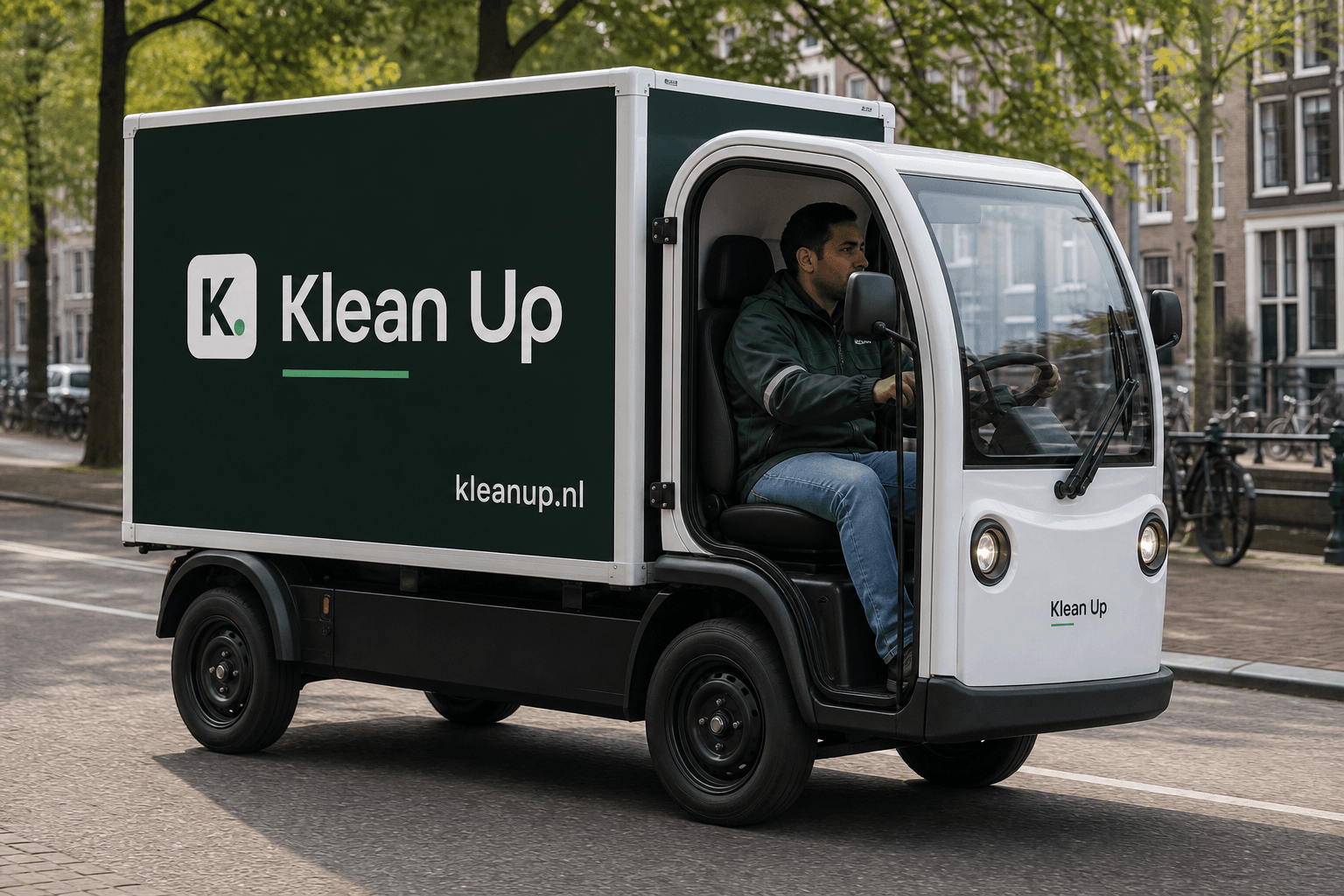
In the neighbourhood
No garbage truck blocking the street, but a compact electric cart that fits between the bikes and the trees. Quiet enough for the early morning, small enough for the canal — and recognisable enough that the neighbourhood knows who's cleaning up.
Where things stand
In talks with the Nieuw-West city district about a structural service — September 2026.
Who it's for
Public-space management, neighbourhood teams and city districts — plus homeowner associations, property managers and shopping districts that want the same approach: report, priority, execution and proof.
How it works
Why Klean Up
Municipalities already have reporting channels. The bottleneck comes after: prioritising, bundling, executing and showing what happened. That's exactly the part Klean Up takes care of.
Born from hands-on experience with litter and neighbourhood participation: in one cleanup pilot, eleven school classes collected ±250 kilos of waste together.
Start with one neighbourhood: €10,600 ex. VAT · 90-day pilot · electric company cart included. With proof on agreed KPIs — without a major tendering process.
Who's behind it
Klean Up started small and that's its strength: whoever drives the cart is the same person who sends the photo back to the reporter. The software around it is built by Deco-AI.
Father and son drive the rounds themselves: reporting, collecting, separating, disposing and the before/after photo back in the app. No layer between reporter and execution.
A team of AI agents reads every report, bundles duplicates, proposes priority and route and builds the weekly report. The proposal is the agent's — the decision is a human's.
Before a cart heads out, someone reviews quality and privacy: no recognisable people or licence plates in shared images. GDPR-compliant, explainable, manageable.
A Deco-AI initiative
Deco-AI builds practical AI applications for work that happens outdoors — from natural stone to public space. Klean Up is the first initiative that's out on the street.
About Deco-AIContact
One working session. We look at your reporting volume and show what a pilot with one neighbourhood, one team and measurable goals looks like.